30/10/2026
E-Way Bill for Courier 2026: Limit, Rules, Who Generates It
When a courier shipment needs an e-way bill, the ₹50,000 limit, who generates it, validity, edit and cancel rules, and penalty.
Read MoreAn e-way bill for courier shipments is needed when the goods in one consignment are worth more than ₹50,000, including GST. Many online orders are below this limit and do not need one. High-value parcels, bulk orders and B2B loads usually do, and the seller is normally the one who generates it on the e-way bill portal before the courier picks up the shipment.
This guide explains when an e-way bill for courier shipments is required, the state-wise limits, who generates it, how to make one for an unregistered buyer or a bill-to-ship-to order, how long it stays valid, how to edit or cancel it, the penalty for missing it, and how to enter the EWB number on your BlitzShipz orders when you ship.
Key facts
What it is: An electronic document under GST, created on the government portal (ewaybillgst.gov.in), for moving goods worth more than ₹50,000.
Limit: Consignment value above ₹50,000, including GST, for inter-state movement. Some states use ₹1,00,000 for movement within the state.
Who generates it: The supplier or the buyer, if registered under GST. If neither does, the transporter must.
Validity: 1 day for up to 200 km, plus 1 more day for every extra 200 km or part of it.
Edit or cancel: Only Part B (vehicle details) can be updated. It can be cancelled only within 24 hours of generating it.
Penalty: ₹10,000 or the tax evaded, whichever is higher, and the goods can be detained.
At BlitzShipz: You generate the EWB yourself, then enter its number in the EWB number field when you book a parcel or a B2B freight shipment. BlitzShipz terms ask for an e-way bill on shipments above ₹50,000.
Quick check: do you need an e-way bill for courier shipments?
|
Check |
If the answer is… |
What it means |
|
1. Is the consignment worth more than ₹50,000, including GST? |
No |
You do not need one, except for handicraft or job work goods sent to another state |
|
2. Are the goods exempt, such as jewellery or used household goods? |
Yes |
You do not need one |
|
3. Are the goods moving within your own state? |
Yes |
Check your state’s limit, as some states use ₹1,00,000 |
If the value is above the limit, the goods are not exempt and the state limit is crossed, generate the EWB before pickup.
In this guide: What it is · When it is required · Limit · Who generates it · How to generate · Bill to ship to · Validity and extension · Edit or cancel · Exemptions · Penalty · Mistakes · How BlitzShipz helps · FAQs
Shipping orders worth more than ₹50,000? In BlitzShipz, you enter the EWB number in the EWB number field when you book, so it is saved with the order.. Start adding e-way bills to your courier orders →
An e-way bill (EWB) is an electronic permit under GST that you need to move goods above a set value from one place to another. It is created on the government’s portal and carries a unique EWB number.
It has two parts:
|
Part |
What it contains |
Who fills it |
|
Part A |
Recipient’s GSTIN, delivery pin code, invoice number and date, value of goods, HSN code, reason for transport and transport document number |
Supplier, buyer or transporter |
|
Part B |
Vehicle number |
Transporter |
The legal rules are in Rule 138 of the CGST Rules, 2017.
Yes, an e-way bill for courier shipments is required when the consignment value is above ₹50,000. GST rules do not treat courier parcels differently from other goods. What decides it is the value, the type of goods and whether the movement is between states or within one state.
|
Situation |
EWB needed? |
|
Online order worth ₹8,000 sent to another state |
No |
|
Laptop order worth ₹65,000 sent to another state |
Yes |
|
Order worth ₹60,000 sent to a buyer without GST registration in another state |
Yes (enter URP as the buyer’s GSTIN) |
|
B2B order worth ₹1,20,000 sent within Maharashtra |
Yes (state limit is ₹1,00,000) |
|
B2B order worth ₹80,000 sent within Delhi |
No (state limit is ₹1,00,000) |
|
Stock worth ₹70,000 moved to your own warehouse in another state |
Yes |
|
Customer return or RTO worth ₹60,000 coming back to you from another state |
Yes |
|
Handicraft goods sent to another state by a seller exempt from GST registration |
Yes, at any value |
|
Goods sent to a job worker in another state |
Yes, at any value |
|
Jewellery or used household goods |
No, these are exempt |
If you send electronics by courier, here is a guide on how to courier a laptop safely, with packing and insurance tips.
The e-way bill limit is a consignment value of more than ₹50,000 for movement between states. The consignment value is the value on the invoice, bill of supply or delivery challan, and it includes GST and cess. If one invoice has both taxable and exempt goods, the exempt goods are left out.
For movement within a state, some states have set a higher limit:
|
State |
Limit within the state |
|
Delhi, Maharashtra, Tamil Nadu, Punjab, Bihar, Jharkhand, Madhya Pradesh |
₹1,00,000 |
|
Rajasthan |
₹1,00,000 (₹2,00,000 for some goods moved within the same city) |
|
West Bengal |
₹50,000 (reduced from ₹1,00,000 in December 2023) |
|
Most other states |
₹50,000 |
State limits change from time to time, so check your state’s latest notification on the GST portal before you ship.
The seller usually generates the EWB, because the seller has the invoice and the GST details. Rule 138 sets out who is responsible:
Registered supplier: Generates it before the goods move. This is the most common case for online sellers.
Registered buyer: Generates it if the supplier has not, for example when the buyer arranges the pickup.
Transporter: If neither has generated it, the supplier fills Part A on the portal and the transporter generates the bill from it.
Courier agency or e-commerce operator: Can fill Part A for the seller, but only with the seller’s authorisation.
Unregistered seller: Can generate one if they choose. A registered buyer who receives goods from an unregistered seller must generate it.
Every e-way bill for courier service bookings should be ready before pickup. BlitzShipz terms ask you to provide one for shipments above ₹50,000 and to keep a valid invoice inside the parcel. Without it, the shipment may be held, returned or disposed of.
You generate an EWB on the portal at ewaybillgst.gov.in. Here is the process for a seller:
Register on the portal. Register with your GSTIN, then log in. Transporters without a GSTIN can enrol and get a transporter ID.
Keep the invoice ready. You need the invoice number and date, the buyer’s GSTIN (if registered), the delivery pin code, HSN codes, quantity, value and GST rate.
Choose “Generate New”. Select outward supply, the sub-type (for example, supply) and the document type (invoice, bill of supply or delivery challan).
Fill Part A. Enter the supplier, buyer, goods and value details. Check the bill-to and ship-to addresses carefully. Here is the difference between a billing address and a shipping address if you are unsure which goes where.
Add the transport details. For a courier shipment, enter your courier partner’s GSTIN or transporter ID in the transporter field, and the courier partner fills Part B. Part B (vehicle number) is not needed if the goods move up to 50 km within your state to the transporter’s place of business.
Submit and save the EWB number. Print or download the bill, or save the EWB number, and add it to your shipment before pickup.
The portal only accepts documents dated within the last 180 days. This time limit applies from 1 January 2025, as per a GSTN advisory of 17 December 2024.
For a buyer without GST registration, enter URP (unregistered person) in the buyer’s GSTIN field, and fill in the buyer’s name and delivery address. Many online buyers fall in this group. You, as the registered seller, still generate the bill when the order is above the limit.
Stock sent to your own warehouse needs a bill too, if the value is above the limit. In another state, it counts as a supply under GST, because that warehouse has its own GSTIN, so raise a tax invoice. For a move under the same GSTIN, such as within one state, use a delivery challan and choose “For Own Use” as the sub-type.
Returns and RTO shipments above the limit need a bill too, because a return is also a movement of goods. The seller usually generates it as the recipient: choose Inward, then “Sales Return”, and use a delivery challan.
2026 update: GSTN had planned two portal changes from 1 August 2026: a mandatory Ship-To GSTIN for bill-to and ship-to transactions, and a facility to close an EWB after delivery. Both were put on hold on 29 July 2026 (GSTN Advisory 668), and no new date had been announced as of October 2026.
In a bill-to-ship-to order, only one EWB is needed, and either the supplier or the party who placed the order can generate it. One party is billed, and the goods go to another address.
For example, Seller B ships goods directly to Customer C, but bills Buyer A, who placed the order:
|
Who generates the bill |
Bill To |
Ship To |
Invoice used |
|
Seller B (who ships the goods) |
Buyer A |
Customer C |
B’s invoice to A |
|
Buyer A (who placed the order) |
Customer C |
Customer C, with “Dispatch From” as B’s address |
A’s invoice to C |
This follows a Finance Ministry press release of 23 April 2018. Choose the “Bill To - Ship To” transaction type on the portal.
E-way bill validity is 1 day for up to 200 km, plus 1 more day for every extra 200 km or part of it. Over-dimensional cargo gets 1 day for every 20 km.
|
Distance |
Validity (normal cargo) |
|
Up to 200 km |
1 day |
|
201 to 400 km |
2 days |
|
401 to 600 km |
3 days |
|
Every extra 200 km |
1 more day |
Validity starts when Part B is first filled, and the first day ends at midnight of the next day.
Distance limit: The portal works out the distance from the two pin codes. You can enter a shorter distance, but not more than 10% above the portal’s figure.
Extension: If a shipment is delayed, the transporter in charge can extend the bill within 8 hours before or after it expires, with a reason. The total period cannot go beyond 360 days from the date it was first generated (from 1 January 2025).
No, you cannot edit an e-way bill once it is generated. You can only update Part B (vehicle details) while it is valid. If any other detail is wrong, cancel the bill and generate a new one.
Cancel within 24 hours: Open the Cancel option on the portal, enter the EWB number, choose a reason and submit. This works only if the goods have not moved, or have not moved as per the details in the bill, and the bill has not been checked in transit.
After 24 hours: You cannot cancel it. The bill stays on record until its validity ends.
Rejection by the buyer: The recipient can reject the bill within 72 hours of it being shown to them, or before delivery, whichever is earlier.
You do not need an EWB when the value is within the limit, or when the goods or the movement are exempt under Rule 138(14). The common exemptions are:
Goods listed in the rule’s annexure, such as jewellery, currency, used household and personal goods, and postal baggage sent by the Department of Posts
Goods carried in a non-motorised vehicle, such as a hand cart
Goods that are exempt from GST, such as fresh fruits and vegetables, milk and books
Alcoholic liquor, petrol, diesel, crude oil, natural gas and aviation turbine fuel
Goods moved up to 20 km to a weighbridge and back, with a delivery challan
Movement within areas notified by the state
Even below ₹50,000, you can choose to generate a bill. Some sellers do this for high-value parcels so the paperwork is ready if a shipment is checked.
Under Section 122 of the CGST Act, the penalty for moving goods without a valid EWB is ₹10,000 or the tax evaded, whichever is higher. Tax officers can also stop and detain the goods and the vehicle.
Under Section 129, to release detained goods, the owner pays a penalty of 200% of the tax due on them. If the owner does not come forward, the penalty is 50% of the value of the goods or 200% of the tax, whichever is higher. These amounts apply from 1 January 2022, under Notification No. 39/2021–Central Tax. For a seller, the bigger cost is often the delay: the buyer waits, and the order may be cancelled or returned.
Moving B2B loads of 20 kg or more? BlitzShipz Freight takes the consignee’s GST, the invoice, the EWB and the box dimensions in one LR booking. Start booking B2B freight with e-way bill details →
The most common mistakes are counting the value without GST, a wrong pin code and invoice details that do not match. Avoid these:
Counting the value without GST. The limit is checked on the value including GST, so a ₹45,000 order plus 18% GST is above ₹50,000.
Wrong pin code or distance. Validity is worked out from the distance, so a wrong pin code can make the EWB expire before delivery.
Mismatched invoice details. The invoice number, date and value must match the EWB exactly.
Leaving the GSTIN blank for a consumer. Enter URP for a buyer who is not registered.
No invoice inside the parcel. Keep a copy of the invoice with the goods, along with the EWB.
Ignoring the state limit. A shipment within your state may need a bill at ₹50,000 in one state and not in another.
Forgetting handicraft and job work rules. These need a bill at any value when sent to another state.
Not extending a delayed bill. If a shipment is stuck, ask the transporter to extend the EWB within 8 hours before or after it expires.
Using an old invoice. Documents older than 180 days cannot be used to generate an EWB.
When you ship orders above the ₹50,000 limit, your shipping platform should let you save the EWB number with each order and track every shipment in one place. Use this checklist when you compare options:
|
What to check |
Why it matters |
BlitzShipz |
|
A field to add the EWB to the order |
The bill travels with the shipment and is not lost in email |
Yes, for parcels and B2B freight |
|
B2B freight booking for heavy loads |
High-value B2B orders are often above 20 kg |
Yes, BlitzShipz Freight for 20 kg and above |
|
Consignee GST and invoice upload for B2B |
Officers and the receiver check these details |
Yes, in Freight bookings |
|
Multi-box shipments |
B2B orders often go in several boxes |
Yes, with dimensions for each box |
|
Invoice printing |
You need a clean invoice for every parcel |
Yes, A4 or 4 per page |
|
Rate and serviceability check |
Long routes cost more and take longer |
Yes, real-time rate and serviceability checks |
|
Live tracking across courier partners |
You see delays early and can extend the bill in time |
Yes, one dashboard |
BlitzShipz is a courier aggregator, so you get these from one account across multiple courier partners. Here is what a courier aggregator is and how it works.
BlitzShipz lets you book parcels and B2B freight from one account, with the EWB number saved on each order and every shipment tracked in one dashboard.
EWB number field: Generate the e-way bill for courier orders yourself on the government portal, then enter its number in the EWB number field when you book. BlitzShipz doesn't generate e-way bills. Mark the parcel as fragile if needed.
Invoices and labels: Print invoices in A4 or 4-per-page format, and labels with your logo in Premium Color, Essential Mono or Thermal style.
Courier choice: Check rates and serviceability for your pickup and destination pin codes in real time, and use smart courier selection to pick a suitable partner.
LR-based booking for shipments of 20 kg and above, with consignee GST, invoice upload, EWB and dimensions for each box.
One pickup request covers all the manifested shipments at a warehouse, and you can book pickups up to 30 days ahead, except Sundays.
Zone-to-zone B2B rate card and calculator, so you know the cost before booking.
Track every shipment across courier partners in one dashboard, so you can spot a delay before the EWB expires.
The AI Caller calls the buyer when a delivery fails, and you get an instant WhatsApp alert when an order enters NDR.
Reverse pickups follow your return policy. Here is how RTO and return management works on BlitzShipz.
Raise weight disputes from the dashboard, and BlitzShipz takes them up with the delivery partner.
Multiple courier partners, 28,000+ pin codes, next day and express delivery, and door-to-door pickup and delivery. COD remittance is processed daily on a T+4 cycle, which is 4 working days from the date the order is delivered, with no hidden charges. You also get bulk shipping and integrations with Shopify, WooCommerce and Wix, or the Open API. Sign up free, complete KYC and get instant activation. Support is on +91-120-5106784 or WhatsApp, Monday to Saturday, 9:30 AM to 6:30 PM.
Parcels and B2B freight in one account. BlitzShipz accounts are free, and activation is instant once your KYC is done. Explore the BlitzShipz seller dashboard →
This guide is general information based on the CGST Rules and state notifications as of October 2026. Check the GST portal or ask your tax adviser for your specific case.
Sources used in this guide: Rule 138 of the CGST Rules, 2017; Sections 122 and 129 of the CGST Act, 2017; Notification No. 39/2021–Central Tax (21 December 2021); GSTN advisory of 17 December 2024 on document age and extension limits; Finance Ministry press release of 23 April 2018 on bill-to-ship-to; GSTN Advisory 668 (29 July 2026); BlitzShipz Terms and Conditions, Section 8.
When a courier shipment needs an e-way bill, the ₹50,000 limit, who generates it, validity, edit and cancel rules, and penalty.
Read More
Delhi to Mumbai courier guide: cost, delivery time, air vs surface and documents.
Read More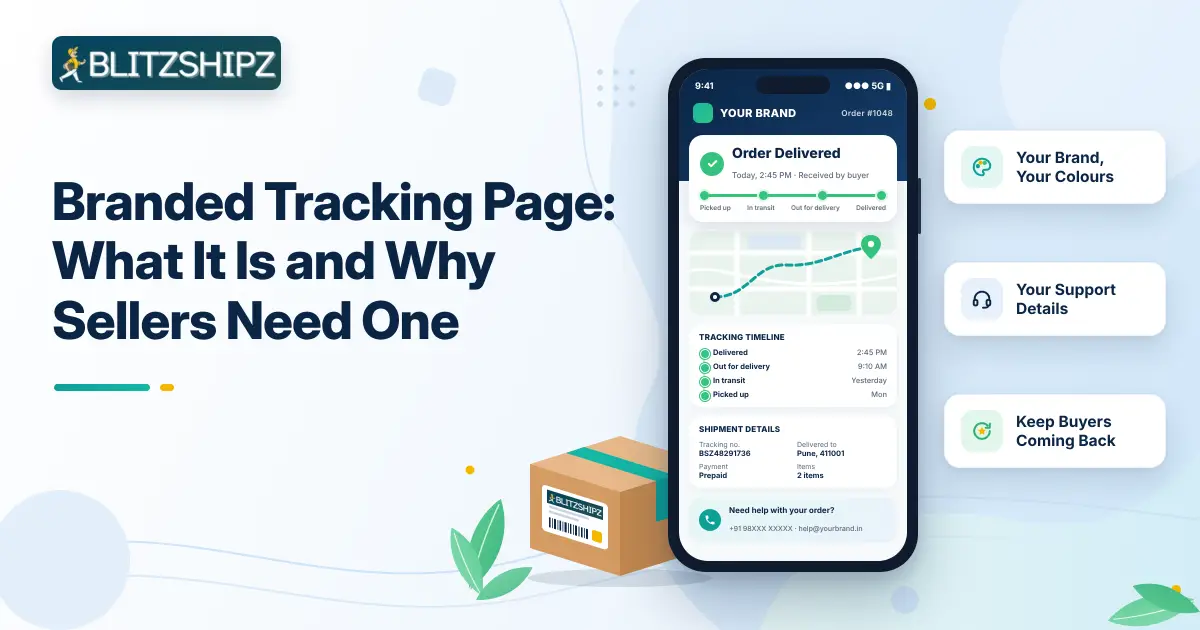
Branded tracking page explained: what to include, how it cuts WISMO queries, and how to add one to your store.
Read More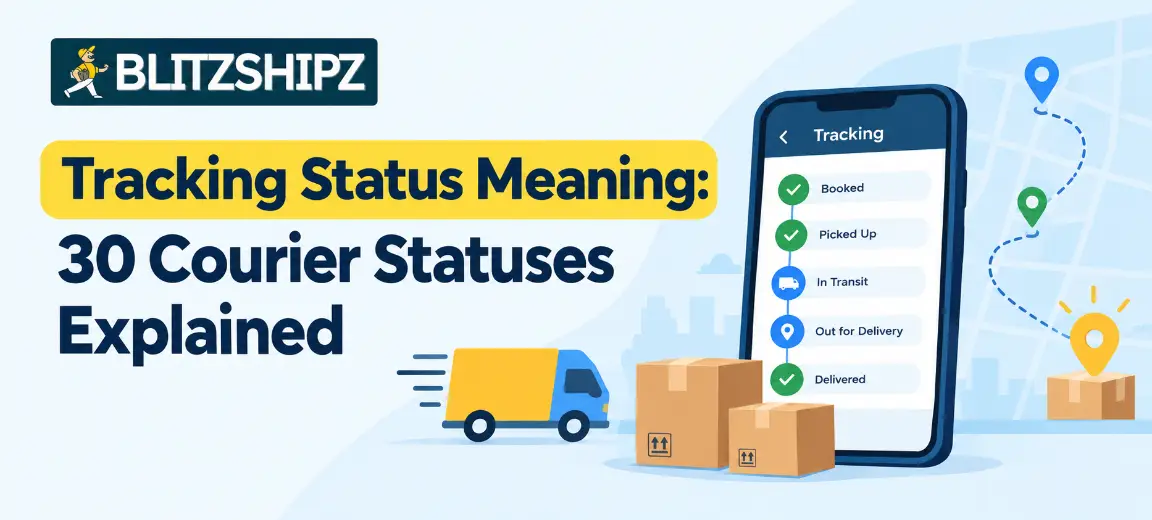
Tracking status meaning: 30 courier statuses explained in order, plus short forms and what to do when a status is stuck.
Read More
Shipping zones in India explained: the 5 courier zones, how they affect charges, and how to set zones in your store.
Read More