14/10/2026
Weight Discrepancy: Why Couriers Charge Extra and How to Dispute It
Weight discrepancy is the gap between your declared and billed weight. Learn why it happens, how to prevent it and how to raise a weight dispute.
Read More
Key Facts:
Weight discrepancy is the gap between the weight you declare at booking and the weight the courier bills you for.
Couriers bill the higher of dead weight and volumetric weight, rounded up to their weight slab, commonly 500 g.
Volumetric weight is length × breadth × height in cm divided by a set divisor. 5,000 is common for domestic shipments, but your rate card states the exact one.
Most discrepancies come from booking product weight instead of packed weight. Only genuine hub errors are worth disputing.
Dispute windows are short, sometimes just one day, so check extra weight charges daily.
You packed an order, weighed it at 1 kg and booked it at 1 kg. A few days later, your wallet shows a deduction for 1.5 kg. That gap between the weight you declared and the weight you were billed for is called a weight discrepancy. It is one of the most common billing complaints among Indian online sellers.
A single discrepancy costs a few rupees. Repeated across hundreds of orders, it becomes a real monthly expense that most sellers never track. This guide covers:
what weight discrepancy is and why it happens
how to tell a genuine courier error from your own booking mistake
how to raise a weight dispute with the right proof
Weight discrepancy is the difference between the weight you declare when you book a shipment and the weight the courier finally charges you for. When the courier’s weight is higher, the extra amount is deducted from your wallet or added to your invoice.
Three weights decide your bill:
|
Weight |
Who records it |
What it means |
|
Declared weight |
You, at booking |
The weight entered against the AWB |
|
Dead weight |
Courier’s scale |
What the packed parcel actually weighs |
|
Chargeable weight |
Courier’s billing |
The higher of dead weight and volumetric weight, rounded up to the courier’s weight slab |
You always pay on chargeable weight. If you are unsure which number to enter at booking, it helps to understand the difference between net weight and gross weight. The courier weighs the gross (packed) parcel, not the product alone.
Large courier hubs in India weigh and measure parcels automatically. Conveyor scanners record the weight and dimensions as each parcel passes, and these readings are then compared with your booking details.
The courier charges the higher of dead weight and volumetric weight. Volumetric weight is based on box size:
Volumetric weight (kg) = Length × Breadth × Height (cm) ÷ 5,000
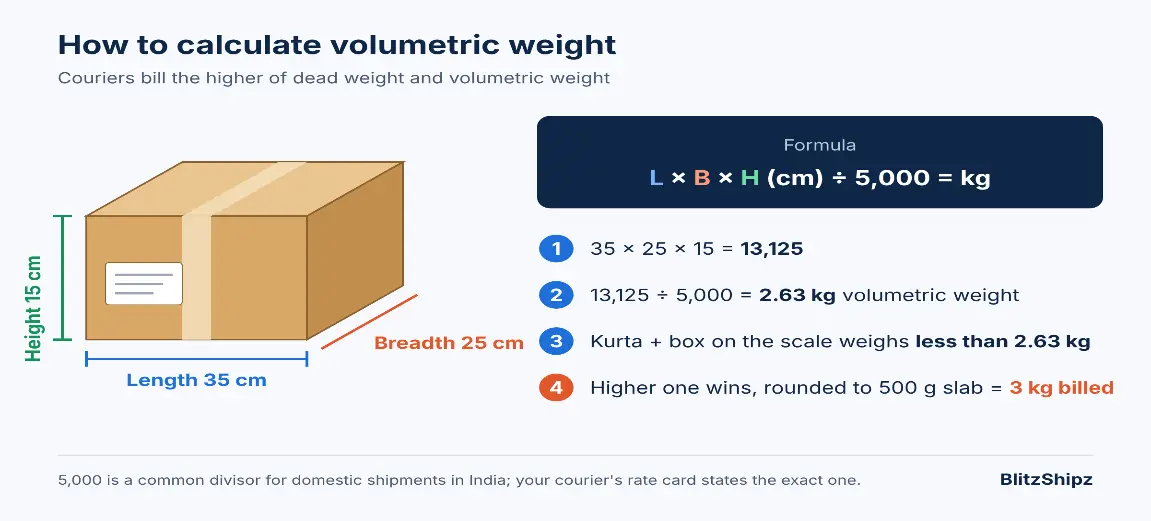
A divisor of 5,000 is common for domestic shipments in India, but your courier’s rate card states the exact divisor it uses. For a full walkthrough, see how volumetric weight is worked out.
The higher-of rule is not limited to private couriers. India Post also charges its premium Speed Post services on the higher of volumetric or gross weight. This rule comes from the Post Office (Second Amendment) Regulations, 2026, in force since 17 March 2026.
Weight discrepancy usually happens for one of two reasons: the packed parcel is heavier or bigger than the weight you declared, or the courier rounds up to its weight slab. Most cases come from one of these six causes:
Product weight declared instead of packed weight. The box, bubble wrap, filler and label all add grams. What to do: weigh the sealed parcel and book that figure.
A box that is too big for the product. Large, light parcels get billed on volumetric weight. What to do: use a box that fits the product with only the padding it needs.
Slab rounding. Rate cards price in weight slabs, commonly 500 g. India Post’s domestic Speed Post Parcel tariff, for example, adds a charge for each further 500 g or part of it, so a parcel at 1.04 kg moves into the 1.5 kg slab. What to do: check the slab shown at booking, not just the weight you typed.
Bulging or soft packaging. Poly mailers and overstuffed boxes measure larger at the hub than on your packing table. What to do: pack consistently and measure the outer size of the finished parcel.
An unverified scale. If your scale reads light, every booking is under-declared. What to do: test it with a known weight and keep it verified.
Genuine hub errors. Scanners can misread a crushed or tilted parcel. What to do: compare the courier’s record with your packing proof and raise a dispute.
The first five are usually fixable on your side. The last one is the one worth disputing.
A small gap at booking can add a full slab to your bill, and a box that is too big can cost several slabs more.
For example, a seller ships a cotton kurta weighing 950 g. Packed in a poly mailer with tissue, it weighs 1.04 kg, but the seller books it at 1 kg. The rate used below is only an illustration: ₹40 per 500 g slab.
|
Scenario |
Declared |
Billed |
Extra cost |
|
Poly mailer, booked at 1 kg |
1 kg (2 slabs) |
1.5 kg (3 slabs) |
₹40 |
|
Same kurta in a 35 × 25 × 15 cm box |
1 kg (2 slabs) |
3 kg: volumetric 2.63 kg, rounded up (6 slabs) |
₹160 |
|
Poly mailer, booked at 1.04 kg |
1.04 kg |
1.5 kg, shown at booking |
₹0 surprise |
The first two usually cannot be disputed, because the courier billed correctly. If 100 of your 500 monthly orders slip one slab higher, that is ₹4,000 a month, or ₹48,000 a year, at this example rate. Checking how shipping rates are calculated for each route before booking shows the slab you will actually pay for.
Know your rate before you ship. On BlitzShipz, Indian sellers can compare courier rates across partners before booking each order. Create your free BlitzShipz account
Sometimes. Some couriers charge light flyer (poly mailer) shipments on dead weight alone up to a set weight limit, while boxes are charged on the higher of dead weight and volumetric weight. Your rate card states the exact rule.
In practice, this means:
Soft, light products such as clothing, scarves or documents are usually cheaper in a flyer. Where flyers are charged on dead weight, box size cannot push the bill up.
Fragile or rigid products such as glass, electronics or cosmetics need a box. Choose the smallest box that protects them, because every extra centimetre adds volumetric weight. Do not cut packaging so far that the product is likely to break; a damaged return costs far more than one extra slab.
Overfilled flyers that bulge out of shape are more likely to be flagged at the hub, so do not stuff a flyer to avoid using a carton.
Rules differ between couriers, so confirm how your courier treats flyers before you change packaging.
To raise a weight dispute, find the AWB, rule out your own error, collect proof and submit one claim per shipment. A dispute succeeds when you can prove that the parcel you handed over was lighter or smaller than what was billed.
Act fast. Dispute windows are short, and some close within just one day of the charge appearing. So check flagged shipments daily, not monthly. If you ship through BlitzShipz, you can raise the weight dispute from your dashboard and the team takes it up with the courier partner for you, so you don’t lose time chasing each courier separately.
Rule out your own error. Re-pack an identical order and weigh it. If it matches the courier’s figure, correct your booking data instead of disputing. Also check your rate card for the volumetric divisor and slab rules, because a higher bill can still be correct.
Collect proof for that exact shipment. Couriers usually ask for the package weight in grams, the dimensions in cm and package photos.
Raise one claim per AWB. Include your AWB (Air Waybill) number and order ID, with all evidence attached in the first submission. The AWB number is the reference that identifies and tracks your shipment.
Record the claim ID. If a claim is rejected without a reason, ask for the hub’s weight and dimension record.
Report patterns. If the same product keeps getting flagged, send one consolidated note instead of repeated single claims.
A photo of the sealed parcel on a scale, with the reading and shipping label in the same frame
Photos of the parcel measured on all three sides with a tape
The AWB number and order ID
The weight and dimensions you declared at booking
Weight dispute message you can copy. Keep the claim short and factual, and replace the brackets with your shipment’s details.
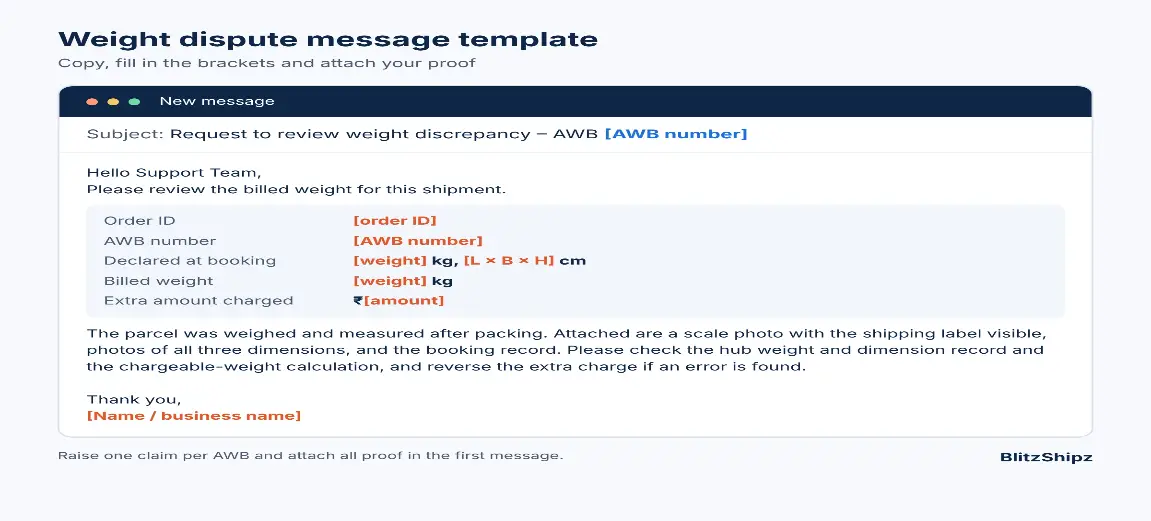
Subject: Request to review weight discrepancy – AWB [AWB number]
Hello Support Team,
Please review the billed weight for this shipment.
Order ID: [order ID]
AWB number: [AWB number]
Declared at booking: [weight] kg, [L × B × H] cm
Billed weight: [weight] kg
Extra amount charged: ₹[amount]
The parcel was weighed and measured after packing. Attached are a scale photo with the shipping label visible, photos of all three dimensions, and the booking record. Please check the hub weight and dimension record and the chargeable-weight calculation, and reverse the extra charge if an error is found.
Thank you,
[Name / business name]
Most rejected claims fail on proof, not on the facts. Avoid these mistakes:
The label is not in the photo. Without the AWB visible, nothing links the scale reading to that parcel.
The product was measured, not the packed parcel. The courier measures the outer packaging, so your proof must too.
The scale reading is unclear. A blurred display or a photo taken at an angle is easy to reject.
Several AWBs in one claim. Each shipment needs its own claim with its own proof.
The claim was raised late. Once the dispute window closes, even a valid claim may not be accepted.
The declared weight was product weight. If you booked net weight, the courier’s higher figure is usually correct.
The rate card was ignored. If the volumetric divisor or slab rules produce the higher weight, the bill is correct and the claim will fail.
Keep every shipment’s details in one place. BlitzShipz gives sellers a single dashboard for orders across courier partners, so the AWB and booking details you need for a dispute are easy to find. Create your free BlitzShipz account
You can prevent most weight discrepancy by booking the packed weight, using a verified scale and fixing one box size per product. These habits help:
Book packed weight, never product weight. Make it a rule for everyone who books orders.
Keep your scale verified. Electronic scales used in trade must be verified and stamped under your state’s Legal Metrology rules. The Delhi Legal Metrology department, for example, lists one year as the validity of an electronic scale’s stamp. A stamped scale also makes your photo proof harder to question.
Fix one box size per product. Save its packed weight and dimensions so every booking uses the same figures. If your orders come in automatically from your store, check how order details sync from Shopify, WooCommerce, Wix or an open API, because the product weight saved in your store becomes the declared weight.
Use the smallest safe packaging. A box that fits the product closely keeps volumetric weight down.
Stay away from slab edges. With 500 g slabs, a parcel at 1.02 kg costs the same as one at 1.49 kg, so trim packaging or declare the higher slab honestly.
Photograph high-value and repeat-flagged orders at packing. It takes seconds and gives you ready proof.
Audit extra charges every week. Review weight deductions in your wallet or invoice so patterns show up early.
Sellers shipping hundreds of orders a day should standardise this at the warehouse level; see how high-volume sellers manage batches of shipments. BlitzShipz sellers can share the AWB and proof with the support team at +91-120-5106784, Monday to Saturday, 9:30 AM to 6:30 PM.
BlitzShipz is an AI-driven shipping platform that helps Indian online sellers cut surprise weight charges and manage every order in one place.
Free account, quick start: sign up free, complete KYC, add your warehouse and start shipping.
See the slab before you pay: compare rates, delivery time and serviceability across 20+ courier partners for each order, so you know the weight slab and price before booking.
Weight dispute help: raise a weight dispute from the dashboard, and the BlitzShipz team takes it up with the courier partner for you.
Every AWB in one dashboard: booking details, AWB numbers and live tracking for all couriers in one place, which keeps dispute proof easy to find. Customers get a branded tracking page.
Correct weights from your store: connect Shopify, WooCommerce, Wix or the open API, or use a bulk upload sheet, so saved product weights and dimensions come in automatically.
28,000+ pin codes, with same day delivery in 9 metro cities, express delivery and door-to-door pickup.
COD with T+4 remittance, plus AI calls or WhatsApp messages to confirm COD orders before dispatch.
Fewer RTOs: customers confirm their address on WhatsApp before dispatch. If a delivery fails, an AI call asks the customer what went wrong and you get an instant WhatsApp alert. Reverse pickups are tracked back to your warehouse.
Real support: call +91-120-5106784, email mailto:info@blitzshipz.com or chat on WhatsApp, Monday to Saturday, 9:30 AM to 6:30 PM.
BlitzShipz is listed among the Top 10 AI-Enabled Logistics Startups (SiliconIndia, March 2026).
Weight discrepancy is the gap between your declared and billed weight. Learn why it happens, how to prevent it and how to raise a weight dispute.
Read More
You can courier most sweets within India. Learn which sweets last, how to pack them and FSSAI rules for sellers.
Read More
An NDR means a delivery attempt failed, not that the order is lost. Here is what each reason code means and how to save the order
Read More
You reduce RTO in ecommerce by fixing the order before it ships and rescuing it before it comes back: validate addresses and phone numbers at checkout
Read More
The e-commerce and D2C landscape in India have changed dramatically in recent years, and 2026 is no exception.
Read More